Tuesday, September 2, 2014

6 List Building Mistakes to Avoid Like the Plague

6 List Building Mistakes to Avoid Like the Plague

What is the single most important thing to an Internet business? I hear this question more than almost any other. And the answer is always the same — you NEED an email list of prospective clients. And not just any list… you need a warm, receptive, QUALITY list. Not just a collection of names and emails, but a fan club of sorts — a group of active, raving fans that will sing your praises to anyone who will listen.
Sound good?
Now, of course, a list like that takes time and effort… but it’s entirely possible. Thousands of others have done it, and you can do it too.
But, like a lot of things in this business, there are some serious pitfalls that can trip you up along the way. Here are the top 6 that can stop you dead in your tracks.

#1 Not Knowing Who Your Audience Is (And What They Need)

Of course you know who your audience is, right? After all, they signed up to receive emails from you about your topic — that’s what they want, right?
Well… not necessarily. Perhaps they signed up because they wanted your free PDF on creating squeeze pages — but what they REALLY want is to know how to write great email copy.
Because, let’s face it, in this world of free reports and PDF downloads… there are going to be a LOT of people that join your list just to get the “ethical bribe” you are offering them. They are not giving you their email so you can send them more emails, they are giving you their email as payment for whatever it is you are giving them.
And that’s not a bad thing.
But it IS something that you have to keep in mind when you are crafting your emails. What can you write about that will transform them from someone who downloaded your free report… to a raving fan? What can you talk about, or teach them, or give them so that they actively look forward to each email you send, rather than just another file destined for the trash bin.

#2 Not Building A Relationship With Your List

So what is it, exactly, that is going to build those raving fans?
Is it going to be great content? Killer headlines? Stellar email copy?
Those are all great, but what is REALLY going to keep them coming back time and time again, what is going to make them want to tell their friends to sign up for your list, is the relationship that you develop.
Think about it this way. Say you always bring your car into the same auto shop every time it needs some maintenance. They do quality work there, charge a reasonable rate, and get the job done quickly. You drive in, drop it off, and sit in a small office until it is done.
Nothing wrong with that.
But lets say that one day that shop is closed and you try a different one.
This shop also does quality work, charges a reasonable rate, and gets the job done quickly. But this time; you are met by a happy, smiling mechanic when you drive up. He shakes your hand and asks how your day is going. He is an interesting and personable fellow and the two of you have a great conversation while he is checking your car over, and you leave with a smile on your face.
Which shop do you think you would go to more often?
The truth is, almost everything in business is like this — including Internet Marketing. In fact… especially Internet Marketing.
This is a business where most, if not all, of your contact with your customers is going to be through the computer. And no matter what your product is, or how good it is, there are going to be others who are selling something similar. How many times have you seen someone claim to be selling “the #1 something”?
How do you stand apart? The relationship that you build with your clients.

#3 No Revelation of Self (Not Sharing Stories)

I remember reading something once about the way that friends interact. The person said that if you notice the way that acquaintances interact, it’s usually by commenting on things around them or on current events (“So… nice weather..”) or by asking the other person questions (“How was your day?”), while close friends interact with statements or stories.
They share their experiences and that sharing brings them closer.
You can do this with your list. You don’t have to be all business, all the time. People like interacting with people… and they like hearing about other people’s successes and failures. This holds especially true for anyone successful or famous (and if they have signed up to receive your emails… chances are that they think you are at least one of those).
Share your stories, share your experiences. Keep them relevant, of course, but teaching through a story is one of the oldest ways of communicating — and can be one of the most powerful.

#4 Using a Corporate Voice (Speaking to the List as a Whole, Rather Than as a Individual)

This one really goes along with #3. People want to connect with people, not with corporations. I see so many people get this one wrong. They write as a group of people, to a group of people.
Example:
“All of us here at IM Corp would like to thank all of you for your great response to our last email.”
Speak as a person, talking to the single person who will be reading your email. Even the small personal touch of a “you” instead of a “all of you” can make a huge difference in how your email is received.

#5 Not Communicating Enough With Your List

Okay, so you’ve figured out what your list wants, you’ve sent out a few solid emails and your list is really starting to respond positively… this is a critical time. You’ve started to gain momentum, but if you trail off and only email them every couple weeks or so, your list could soon forget about the relationship you’ve started to build.
How often to mail your list is a tricky question.. because it really varies between people, markets, lists, etc… but generally speaking you should be mailing your list AT LEAST once per week. In fact, once per week is often too infrequent. You don’t want to be annoying… but keep that contact flowing.

#6 Not Getting Started

This is a HUGE one. Let’s face it, sending out emails to a list (even a small one) can be pretty intimidating. Especially when you see so many people talking about the right way to do it, or the wrong way to do it, or the best way to do it. It’s easy to get overwhelmed.
Just get started. Send that first email.
Pay attention to what your list responds to, and what they don’t. Share good content. Build that relationship — you’ll know when it’s working. It can be confusing at first, but you’ll be well on your way to building your businesses single greatest asset.

The Seed Launch: A Simple System for Creating Products That Sell Like Crazy

The Seed Launch: A Simple System for Creating Products That Sell Like Crazy

Heinz… Green Ketchup
Harley Davidson… Perfume
Bic… Underwear
Huh?
I’m thinking those probably aren’t the first words you would associate with these popular brands.
Well, believe it or not, Heinz launched “Green Ketchup”, Harley Davidson rolled out a line of perfume and aftershave, and pen maker, Bic unveiled a line of “disposable underwear”.
Maybe you purchased one of these or NOT?
So, what was the fatal flaw (or deadly product launch sin) that these big brands committed?
Simply put… they created products that the market didn’t want.
So, the big question…
If brands with huge R&D budgets can fall victim to this fatal flaw, then how do we as Entrepreneurs and Information Marketers avoid creating products that our market won’t buy?
It is a natural tendency as entrepreneurs to dream up creative product ideas that we THINK our market will like, but completely miss out on simply asking our audience what it wants and needs.

So, how do we create and launch products that sell?

It’s actually a lot simpler than you would think…
As some of you may know, our fearless leader, Jeff Walker created The Product Launch Formula in 2005 and literally changed the game on how businesses successfully launch products online.
In this ground-breaking program, Jeff introduces a concept called “The Seed Launch”.
The Seed Launch offers the perfect avenue for business owners to converse with their audience, uncover their biggest questions and needs and ultimately identify “what the market wants”.
This type of launch is ideal if you have a small list (30-100 names), no list, or a new product idea you would like to test first before actually creating it.

Here are 9 quick steps to rolling out an effective “Seed Launch”…

1. Send out an email to your small list or make a post in the Social Networks that sounds something like this…

“People have been asking me to teach “Dog Training”  forever and I’ve never really even considered doing it, but I’m thinking of putting together a course. If you’re interested, let me know.
Then, you might include a link to your squeeze page to start building your “Launch List” for this future product.
2.  Create some prelaunch content in the form of a series of emails.
During this prelaunch sequence, give your list an offer (Ie. How to train your dog better).
3. Invite your list to a series of teleseminars or webinars.
Use a free service like FreeConferenceCall.com to set up a bridge line
to run your calls or use a free webinar service like AnyMeeting.
At this point, you’ll need to decide if you’re going to charge for the calls or do it for free. Interestingly enough, when you charge money, people tend to be more compliant and actually show up for the calls or webinars.
The goal here is to get at least 30-40 people on the calls so you have a critical mass.
4. Run a survey to your participants prior to the teleseminar or webinar asking them a question like this…
“If you could sit down and have coffee with me to discuss “Dog Training”, what would be the top two questions you would ask me on this topic?”
At this point, compile the responses (using a tool like SurveyMonkey) and build a list of the top 10 topics they would be most interested in learning about. In fact, these questions will become the basis for your content on the calls.
5. Deliver your first call or webinar and plan on teaching (and answering submitted questions) for anywhere from 45-90 minutes.
6. Send out a follow-up survey after this first call with a couple questions like this…
“What didn’t I cover about this topic that you would like to know more about?”
“Our next call is going to be on XYZ topic… what are your top questions about that?”
Again, take those questions and organize them for your second call or webinar. The massive benefit of these surveys is that you are always get super valuable feedback from your market.
7.  Follow the same process for your second and third call.
8. Offer a bonus webinar or call.
It is critical to ALWAYS over deliver for your clients so if you are planning on doing three calls, then add an unannounced bonus call.
9. Get your call recordings transcribed by a professional.
You’ll now have like 50-70+ pages of transcripts and 3-4 hours of audio/video recordings… talk about a great starting point for your first product launch in this market.
Again, the two powerful benefits of a Seed Launch is that you are creating content based on what your audience is interested in and you’re gaining valuable experience in learning how to teach this material.
Whenever you enter a new market with no product or no list, the “Seed Launch” can be your greatest ally and a repeatable process that positions you to build a fantastic product that your market wants.

The 4-Step Quick Guide to Test Market Your New Product Idea

The 4-Step Quick Guide to Test Market Your New Product Idea

Okay, let’s take a quick detour from reality for a moment…
You’re a 3-time Archery champion in the Unites States. You have a wall full of medals and trophies, and you feel you’ve accomplished everything you set out to do in the sport. So now it’s time to officially retire.
In the last few months, you’ve had this awesome idea for an information product that would teach beginning archers some of the secrets you’ve learned for becoming a world class archer extraordinaire. You’re super pumped about the idea, but continue to be plagued with the nagging question… “Will anyone actually buy my product?”
Okay back to reality…
While you may not be a champion archer, you may have found yourself in a similar place… you have these awesome product ideas (in your mind) that you want to launch on the web, but are not 100% sure if they’ll really fly or not.
Well, there are a few smart, simple (and low-cost) ways to test market your new product idea to ensure you’re launching a product that will actually convert!
Here are four quick steps to consider…
1. Be actively engaged in target forums and social network conversations
Research the top forums in your market and join the conversation. Look at what posts seem to be generating the most comments and make note of common topics that keep resurfacing.
You can also search relevant keyword conversations in Twitter and Facebook or review videos in YouTube and see what common challenges and pain points keep recurring.
Taking our archery example, the archer forums might reveal the most common struggles that a beginner will experience when they’re just starting out. This is golden information that can give you a starting place for the types of things your audience would like to learn more about.
2. Research similar products in your market
If I wanted to create a killer “how to” archery info product, I would spend lots of time Googling relevant keywords to see what types of products currently exist in the market. This research will help you uncover potential gaps in the market, as well as ways to improve upon existing products.
WARNING: One serious pitfall many people fall into is identifying a noticeable gap in the market and just assuming that a product here will sell like crazy. There is still another step that needs to be taken before moving into full product creation mode.
3. Set up a simple squeeze page with a free offer and run a small test
This is a terrific next step… set up a simple squeeze page (opt-in page) that includes a free offer. It might be something like a quick PDF guide revealing “10 Archery Secrets from a Three-Time World Champion”.
Then, test out how the page and offer converts.
Share the squeeze page with your social network connections and in target forums. You might also run a small Google Adwords or Facebook Ads test and see what the conversions look like.
Again, this is a simple way to quickly find out if there’s a potential market for this type of offer.
Now, of course, you may find that you need to test a number of different squeeze pages and offers to see what resonates best with your audience.
4. Run a “Seed Launch” to test market your idea BEFORE you create your product!
The Seed Launch is pure magic when it comes to test marketing a new product idea.
It originated from the creative mind of our fearless leader Jeff Walker, and has been used by thousands of entrepreneurs around the world to effectively test market new product ideas.
There are 9 simple steps to setting up a Seed Launch that are ideally suited for anyone with a new product idea that would like to test their idea before actually creating the product. It’s the perfect way to converse with your audience, uncover their biggest questions and needs, and ultimately identify what the market wants.
So, there you have it… a few ideas for market testing your new product ideas.
Remember, the product creation process doesn’t have to be a guessing game. You can use these practical and repeatable steps to ensure you create killer products your market will buy again and again.

The 3 Critical Roles in a Successful Product Launch

The 3 Critical Roles in a Successful Product Launch

A product launch has a lot of moving parts.swiss knife 300x267 The 3 Critical Roles in a Successful Product Launch
In fact, if I were to break down the typical product launch into all the possible roles for every possible scenario, there would be well over 80 different roles listed here and it would take up several pages.
Fortunately, they can all be lumped under the umbrella of three primary roles within a large scale joint venture (JV) product launch. If you’re doing a simple seed launch or internal launch, you’ll only need to be familiar with the first two.

Product Launch Role #1: The Creative

The writing and creation of all the prelaunch content, the emails, the copy, the videos – essentially, all of the marketing creative required for the launch.
Chances are, you’re going to be heavily involved in the creative piece, even if you’re not writing the copy yourself. Frankly, most people can simply write their own material better than a professional copywriter, because they understand their product or service intimately and can articulate their message better.
So you’ll either need to have some marketing chops yourself or you’re going to need help from someone who does. When our leader Jeff Walker is in a launch, that’s what he’s doing 80% of the time.

Product Launch Role #2: Project Planning

All of the project planning and administration to make sure stuff is getting done.
It includes getting the prelaunch content pages and sales pages built, setting up the product delivery and/or membership areas, testing the links, approving the comments, setting up the shopping cart and testing out the order process, building the site out, putting tracking in place, watching the analytics, customer service and support issues, etc.
Basically, we’re talking about all the logistical and technical here, and it’s the easiest role to outsource or put a team in place for. Depending on the size and complexity of the product launch, this role may be filled by one person or an entire team.

Product Launch Role #3: Affiliate Wrangling

This role doesn’t exist in an internal launch, because you are launching direct to your own lists with no outside support. That’s why internal launches are so much easier to manage.
In a full-blown product launch supported by affiliates, however, this role is crucial… and it’s as much about motivation as it is administration.
On the one hand, it encompasses getting affiliates on board to promote the launch, communicating with them regularly, and making sure they have all the support they need. This includes the logistics of making sure they’re signed up and have the right link… being able to respond to them quickly when questions arise… following who has mailed, who is going to mail, and who needs to be prodded to mail… plus, staying in close touch with the top affiliates and partners.
On the other hand, it’s about getting them riled up and excited about promoting your launch. If you’re going to do a big JV launch, you’ve got to get all of your partners fully on board well before the start of your prelaunch.
To do that, you’ve got to know what motivates them and understand how to use that knowledge to sustain their excitement throughout the entirety of the launch.

How to Radically Increase Your Opt-In Rates… and Grow Your Launch List Like Wildfire!

How to Radically Increase Your Opt-In Rates… and Grow Your Launch List Like Wildfire!

When a prospect comes to your squeeze page, you’re making them an offer of something in exchange for their email address. So in essence, you’re making a sale. It just so happens that instead of giving you money, they’re giving you their permission to send them future messages.
The beauty of a squeeze page, however, is it’s a lot easier to get a conversion. So you can test a lot more quickly than you can with a sales page.
When you’re testing things on a sales letter, you actually need to make a real sale (for real money) in order to get a conversion. And you need to get a considerable quantity of sales to get valid test results. So it can take weeks, or even months, to test out a sales page. With a squeeze page, you can literally do it in a matter of hours with enough targeted traffic.
That said, here are the three primary elements of your squeeze page that have the most impact on the “sale” and how fast you can grow your list for a product launch.

#1: Your Offer

There are lots of terms for your free giveaway: a gift, an ethical bribe, a freebie. Whatever it is, and whatever you call it, getting your offer right is the number one most important thing. You’ve got to work to sharpen your offer and continually make it better.
In simple terms, it’s answering this question:
What can you offer to your prospect that will have a high perceived value and will make them sit up, take notice, and take action by giving you their email address?
When Jeff first started out in 1996, people were eager to get something online for free. So it was relatively easy to get an opt-in. Over the years, people have become far more reluctant to give up their email address. Squeeze pages giving out free information are everywhere, so you’ve got to work hard to make your offer stand out from the crowd.
The secret is to put an intense focus on understanding your target market, and to answer the most important question in your prospects mind in respect to that market. What resource can you give to them that’s going to really get them to move and take action.
It doesn’t have to be complicated. It can just be a short video that addresses their biggest hotpoint, along with a one-page PDF resource guide that goes along with that video.
It’s not so much the “thing” that you give away, but what it addresses:
- What are their hopes, dreams, and aspirations?
- How can you best help them along their journey?
- What’s the number one thing that’s holding them back (that they know is holding them back) and how can you resolve that problem for them?
- How can you take some of their pain away and build their aspirations?
- What is their biggest dream? How can you blow that up, make it bigger, make it more real for them? How can you take that and put it into a video or video series?
Once you’ve answered these questions, take the coolest idea you’ve got and give it away for the opt-in!

#2: Your Headline

Next to the offer itself, the most important element on your squeeze page is always going to be your headline.
Any great copywriter will tell you that 80% of the results you get with a sales page will be based on your headline, and it’s no different with a squeeze page. Your headline must grab your ideal prospect forcefully and communicate your offer quickly!
There are a lot of great headlines out there, and there are a lot of great resources on how to write a great headline, so I won’t go into detail here.
Keep in mind that curiosity is always a powerful motivator. Simply raise a question in their mind that they must get answered by you. Also important is making a big promise in your headline that, in some way, ties in with their deepest fears, dreams, hopes, or aspirations.
Just think, what’s the coolest trick you’ve got up your sleeve that will solve a problem for them or scratch a big itch, and how can you promise that in a great headline?

#3: Your Design

The secret to squeeze page design is this: keep it simple!
Our leader Jeff Walker has found through more than a decade of testing (with millions of opt-ins received on thousands of squeeze pages) that simple squeeze pages, that are not overly busy, work best.
The important thing to remember is that what works always changes over time and is often surprising. Squeeze page designs get tired and gradually lose their edge. So don’t expect to have one squeeze page design for the next decade. You might stick with a squeeze page for a year or more, but you’ve got to constantly keep an eye out for new designs and strategies.
Most importantly, don’t worry about your squeeze page being perfect right off the bat. You should be constantly testing it and changing it to keep abreast of what’s working. Just assume that your first one is going to be a throwaway and start evolving your offer, your copy, and your design from there.

Just get something up there and get started!

3 Keys to Writing a Powerful, Personal Email

3 Keys to Writing a Powerful, Personal Email

Every element of your product launch is important, but every single one of your emails to your launch list is critical.
You have to remember that on the other end of every email you send is a living, breathing person. They’re checking their email in the den, while the kids scream in the background. They’re checking their email on their iPhone in line at the bank, with three more stops to go before getting home to their family.
You could have a list of 1,000… 10,000… even 100,000 names or more, and it will still be the same: you’re not just writing to email addresses on a list, you’re writing to people. They’re individual people, they have individual situations, they have individual needs and desires.
But here’s the critical thing to keep in mind the next time you sit down to write an email:
Even though they lead vastly different lives, they all share one thing in common: they’re
all far too busy, they’re all far too distracted, and they’re all getting far more emails than they’ll ever have time to read!
That’s why your greatest asset in email marketing is your relationship with your list.
You want to be in a situation where, when your email pops up in their inbox, they associate such a profound level of confidence, trust, and value with your name that they immediately want to open your email to see what you have to say.
Last week on our sister blog, I wrote about the 3 key elements for writing an effective “headline” for your emails and how to make your emails leap out of your prospect’s inbox. This week, I want to share with you a simple 3-step process for writing powerful, personal emails that our leader Jeff Walker uses every time he sits down to write.
It all starts with a simple Venn diagram with three concentric circles.

Circle #1: Story

A story about you or someone you know, talking about an experience that is closely related to the action you want your prospect to take.
Sometimes that story will take up significant space in your email, sometimes it will be relatively small, and sometimes there will be no story at all. But most of the time you’ll want to try and have a story, even if that story is covered in just one sentence.
This should often include what we refer to as “revelation of self”. That means telling people a little bit about yourself… opening up to them… talking about things that are happening in your life (without being boring)… letting them get little glimpses into your life. People love that. In fact, the greater your stature and positioning becomes with the people on your list, the more that comes into effect.
People like quick-hitting tactics, so those are good to share from time to time. But people will not stick with you for tactics, and people will not stick with you solely for content. They’re going to stick with you because they feel a connection with you. That means that overwhelming them with content is not the answer.
You win by sharing yourself… being an inspirational figure… celebrating wins (your wins, but more importantly, your reader’s wins)… being a good listener for your readers, and then sharing what you hear, sharing their successes… speaking to a bigger vision for their lives.
Those things are always going to be a win.

Circle #2: Aspirations or Pain Points

You must be clear on who you are publishing to.
What are their hopes, dreams, fears? What keeps them awake at night? What do they aspire to become? What are their biggest obstacles or pain points? What’s holding them back? The more clear you can be on these things, the better you can craft a message that hits them squarely in the heart and mind.
You don’t have to have a perfect understanding of your ideal client and their aspirations when you’re just starting out, but you need to get that understanding as quickly as possible.

Circle #3: Goal or Outcome

You also must be clear on the expected outcome of each email you send.
Generally, it’s getting them to click a link and land on a page, predisposed to taking some kind of action; whether it be to opt-in on a squeeze page, to visit a sales page and buy something, or to make a comment on a blog or Facebook page.
Whatever that expected goal or outcome is, you need to be clear on it and have it firmly in mind at all times. Your entire email needs to guide them towards that expected goal or outcome.
Once you have those three key elements clearly in place, your task then becomes a matter of asking yourself: how can I weave my personal story in with my prospects’ aspirations, so that it naturally leads to a link at the bottom of the email that my prospect will want to click on.
As with anything in life and business, there are no guarantees. But if you get these three key elements right, you’ll be positioned to knock it out of the ballpark more times than not.

Wednesday, August 27, 2014

ANALYSIS: How church attendance affects American attitudes toward Israel

ANALYSIS: How church attendance affects American attitudes toward Israel

Israel benefits from the fact that Americans remain in large part a religious people. But declining ‎religiosity bodes ill for the Jewish state.
What role does religion play in American attitudes towards Israel? An analysis by Frank Newport, the editor-in-‎chief of Gallup Inc., reviews 14 annual Gallup polls from 2001 to 2014, in which respondents answer the same ‎question: "In the Middle East situation, are your sympathies more with the Israelis or more with the ‎Palestinians?" The numbers offer insights different from what one might expect. ‎
The study starts with two basic facts: First, looking at the whole sample of about 14,000 American adults, 59 ‎percent answer that they have more sympathy for Israelis and 16 percent say they have more sympathy for ‎Palestinians, a ratio of almost 4-to-1. Second, Newport finds that "religious Americans are significantly more ‎likely than less religious Americans to be sympathetic to the Israelis," confirming what common sense already ‎tells us. ‎
That said, his numbers contain several noteworthy subtleties: ‎
  • A near-linear relationship exists between church attendance and outlook (see image 2, above): 66 percent of weekly or almost-‎weekly church-goers favor Israel, as do 58 percent of monthly and seldom church-goers and 46 percent ‎of never church-goers. Conversely, sympathy toward the Palestinians is also near-linear: 13 percent, 16 ‎percent, and 23 percent, respectively.
  • In both cases, any church attendance at all makes Christians more alike to each other vs. those who never ‎attend, a difference that has somewhat widened recently.
  • When one looks at religious group (see image 3, above), Jews, Mormons, and non-Catholic Christians are the most pro-Israel; ‎Catholics match the national average; other religious groups and the non-religious are the least pro-Israel. ‎
  • Political views and religiosity both influence Americans' view -- but as independent variables. ‎
  • Political views matter more than religiosity: "Nonreligious Republicans are more likely to sympathize with ‎Israelis than highly religious Democrats."‎
  • Church attendance has more of an impact on Republican views than on Democratic ones. ‎
  • Israel brings together two very politically dissimilar groups, church-attending Republican Christians and ‎Jewish Democrats.‎
Some reflections on these figures: ‎
1) Although religiosity helps explain the difference between the United States and Europe, politics has more ‎importance: that even irreligious Americans favor Israel 2-to-1 marks them as very different from their European ‎counterparts. ‎
2) Given the prominence of Jewish anti-Zionists in the academy, the media, and in Hollywood, the 93-to-2 ‎Jewish support for Israel comes as a surprise, suggesting that the most accomplished and articulate Jews tend to ‎be disproportionately hostile to Israel. Perhaps this is their way of fitting into the leftist institutions where they ‎work and hope to succeed?‎
3) One wishes the "Protestant" category provided further details on the various denominations. How much do ‎the mainline churches differ from the evangelical ones? Do the adherents of anti-Israel churches follow their ‎leadership in this regard? Are there important changes over time? Gallup should inform us about this in the ‎future. ‎
4) Muslims are lumped in with other non-Christians but have a unique profile. In Canada, whose Muslim ‎population differs substantially from the American Muslim community, pro-Israel Muslims number about 20 percent. I estimate ‎that pro-Israel American Muslims number half that percentage or less. Also of note: Religiosity among Muslims ‎has the opposite influence of religiosity among Christians, making them less pro-Israel. ‎
In conclusion, Israel benefits from the fact that Americans remain in large part a religious people. But declining ‎religiosity bodes ill for the Jewish state. ‎

Friday, August 22, 2014

How to change a Multisite primary domain

How to change a Multisite primary domain

  
If you want to change the primary domain of your WordPress multisite installation, there are 5 values to change. There is no need to perform a database dump. This is actually frowned upon, as WordPress stores serialized data in the database, and altering it can cause corruption. Here is a list of the 5 main tables and options that need to be changed (note that we’re assuming your table prefix is “wp_”. If you’re using a different table prefix, replace “wp_” in the following table names with your prefix):
  • wp_options: options named “siteurl” and “home”
  • wp_site
  • wp_sitemeta: the option named “siteurl”
  • wp_blogs: any entries in the “domains” column that have the old domain name
  • wp_#_options: Each sub-site will have sets of tables that correspond to the blog_id in the wp_blogs table. You need to go to the wp_#_options table, where # corresponds to the blog_id, and update the “siteurl” and “home” settings in that table.
WordPress has different rules for different fields. The wp_site and wp_blogs tables can NOT have http:// or a trailing slash at the end of the domain name, whereas in the wp_options table, it is required to have the http:// at the beginning. In the wp_sitemeta table it is required to have http:// at the beginning and a trailing slash at the end.
Also make sure to comment out any pre-defined constants in your wp-config.php file, as they will override settings in the database. Things such as:
define( 'WP_HOME', 'http://example.com' );
define( 'WP_SITEURL', 'http://example.com' );
After that, we have to manually tell our servers which domain is the new primary domain. We can make this change, and push it out in under a couple of seconds.
Note: In most cases you may/will need to update a entry in your WP-Config.php file. The code I would recommend taking a look at is the code snippet here:
define('WP_ALLOW_MULTISITE', true);
define( 'MULTISITE', true );
define( 'SUBDOMAIN_INSTALL', true );
$base = '/';
define( 'DOMAIN_CURRENT_SITE', 'mysite.wpengine.com' );
define( 'PATH_CURRENT_SITE', '/' );
define( 'SITE_ID_CURRENT_SITE', 1 );
define( 'BLOG_ID_CURRENT_SITE', 1 );
On the line that has “define(‘DOMAIN_CURRENT_SITE’,’mysite.wpengine.com’);”
You will replace “mysite.wpengine.com” with your domain. So for example:
define('WP_ALLOW_MULTISITE', true);
define( 'MULTISITE', true );
define( 'SUBDOMAIN_INSTALL', true );
$base = '/';
define( 'DOMAIN_CURRENT_SITE', 'mysite.com' );
define( 'PATH_CURRENT_SITE', '/' );
define( 'SITE_ID_CURRENT_SITE', 1 );
define( 'BLOG_ID_CURRENT_SITE', 1 );
If you need further assistance, please contact tech support.

Friday, August 15, 2014

UPDATE wp_users SET user_pass =md5('newpassword') WHERE user_login = 'yourusername');

UPDATE myprefix_users SET user_pass =md5('newpassword') WHERE user_login = 'yourusername');

UPDATE wp_users SET user_login = 'NewName' WHERE user_login = 'Admin';
UPDATE myprefix_users SET user_login = 'NewName' WHERE user_login = 'Admin';

POPULAR WORDPRESS SQL SCRIPTS: USER ADMINISTRATION

Here are some of the most common WordPress SQL user administration scripts that I run.

Backup! Backup! Backup!

First and foremost, before manipulating the database, ALWAYS back it up!
I am going to assume that you have access via a WordPress SQL Plugin or phpMyAdmin.
Remember, if you are like me and change the prefix, be sure to change the wp_ prefixes below to whatever your prefix is. I have added myprefix_ to help demonstrate where this change would be.

Change Default Administrator Name

12
UPDATE wp_users SET user_login = 'NewName' WHERE user_login = 'Admin';
UPDATE myprefix_users SET user_login = 'NewName' WHERE user_login = 'Admin';

Reset User Password

12
UPDATE wp_users SET user_pass =md5('newpassword') WHERE user_login = 'yourusername');
UPDATE myprefix_users SET user_pass =md5('newpassword') WHERE user_login = 'yourusername');
view rawuser-password.sql hosted with ❤ by GitHub

Delete Orphaned User Meta

12
DELETE FROM wp_usermeta WHERE user_id NOT IN (SELECT ID FROM wp_users)
DELETE FROM myprefix_usermeta WHERE user_id NOT IN (SELECT ID FROM myprefix_users)

Replace User Meta

12
UPDATE wp_usermeta SET meta_key = REPLACE (meta_key, 'old_name', 'new_name');
UPDATE myprefix_usermeta SET meta_key = REPLACE (meta_key, 'old_name', 'new_name');
view rawreplaceMetaKey.sql hosted with ❤ by GitHub

Add New Admin User

In the example below, I am using an ID of 2. Change this number to the next user available, or some safe high number.
1234567
INSERT INTO databasename.wp_users (ID, user_login, user_pass, user_nicename, user_email, user_url, user_registered, user_activation_key, user_status, display_name) VALUES ('2', 'admin_demo', MD5('demo_password'), 'Travis Smith', 'no-reply@wpsmith.net', 'http://wpsmith.net/', '2014-02-15 00:00:00', '', '0', 'Travis Smith');
INSERT INTO databasename.wp_usermeta (umeta_id, user_id, meta_key, meta_value) VALUES (NULL, '2', 'wp_capabilities', 'a:1:{s:13:"administrator";s:1:"1";}');
INSERT INTO databasename.wp_usermeta (umeta_id, user_id, meta_key, meta_value) VALUES (NULL, '2', 'wp_user_level', '10');
 
INSERT INTO databasename.myprefix_users (ID, user_login, user_pass, user_nicename, user_email, user_url, user_registered, user_activation_key, user_status, display_name) VALUES ('2', 'admin_demo', MD5('demo_password'), 'Travis Smith', 'no-reply@wpsmith.net', 'http://wpsmith.net/', '2014-02-15 00:00:00', '', '0', 'Travis Smith');
INSERT INTO databasename.myprefix_usermeta (umeta_id, user_id, meta_key, meta_value) VALUES (NULL, '2', 'myprefix_capabilities', 'a:1:{s:13:"administrator";s:1:"1";}');
INSERT INTO databasename.myprefix_usermeta (umeta_id, user_id, meta_key, meta_value) VALUES (NULL, '2', 'myprefix_user_level', '10');
view rawnew-admin.sql hosted with ❤ by GitHub

Delete Unknown Users

This will delete users not found in comments or as an author of a post. Do not use this script for community sites or sites with Subscribers.
1234567
DELETE FROM wp_users WHERE ID > 1 AND ID NOT IN (SELECT DISTINCT post_author FROM wp_posts) AND ID NOT IN (SELECT DISTINCT user_id FROM wp_comments);
DELETE FROM wp_usermeta WHERE user_id > 1 AND user_id NOT IN (SELECT DISTINCT post_author FROM wp_posts) AND user_id NOT IN (SELECT DISTINCT user_id FROM wp_comments);
DELETE FROM wp_links WHERE link_owner > 1 AND link_owner NOT IN (SELECT DISTINCT post_author FROM wp_posts) AND link_owner NOT IN (SELECT DISTINCT user_id FROM wp_comments);
 
DELETE FROM myprefix_users WHERE ID > 1 AND ID NOT IN (SELECT DISTINCT post_author FROM myprefix_posts) AND ID NOT IN (SELECT DISTINCT user_id FROM myprefix_comments);
DELETE FROM myprefix_usermeta WHERE user_id > 1 AND user_id NOT IN (SELECT DISTINCT post_author FROM myprefix_posts) AND user_id NOT IN (SELECT DISTINCT user_id FROM myprefix_comments);
DELETE FROM myprefix_links WHERE link_owner > 1 AND link_owner NOT IN (SELECT DISTINCT post_author FROM myprefix_posts) AND link_owner NOT IN (SELECT DISTINCT user_id FROM myprefix_comments);

Get All Admins

123
SELECT u.ID, u.user_login, u.user_nicename, u.user_email FROM wp_users u INNER JOIN wp_usermeta m ON m.user_id = u.ID WHERE m.meta_key = 'wp_capabilities' AND m.meta_value LIKE '%admin%' ORDER BY u.user_registered
 
SELECT u.ID, u.user_login, u.user_nicename, u.user_email FROM myprefix_users u INNER JOIN myprefix_usermeta m ON m.user_id = u.ID WHERE m.meta_key = 'myprefix_capabilities' AND m.meta_value LIKE '%admin%' ORDER BY u.user_registered
view rawget-admins.sql hosted with ❤ by GitHub
About Travis Smith
As a WordPress Enthusiast, Travis writes about his journey in WordPress trying to help other WordPress travelers and enthusiasts with tutorials, explanations, & demonstrations of the things he learns.

Change and Update WordPress URLS in Database When Site is Moved to new Host

Change and Update WordPress URLS in Database When Site is Moved to new Host

After migrating a WordPress site to a new URL either live or to a production or development server, the new URL strings in the mysql database need to be changed and updated in the various mysql database tables.
This method just uses the whole mysql database rather than a WordPress export/import from within, and is best suited for a straight swap. So you would copy all the WordPress files/folders to the new destination, set the correct ownership to those files = then do the database switcheroo.

WordPress Database Switcheroo

Do a mysql database export of the old database on the old server, create a new blank database on the new server, import the old data either in phpmyadmin or mysql directly in the command line.
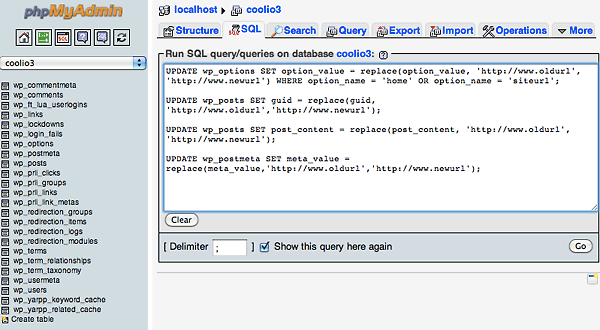
Make sure you have the new database selected, then run some sql updates and replacement commands on the tables notably, wp_options, wp_posts, wp_postmeta.
Use the code as below and swap in your old and new URLs, no trailing slashes. Also if necessary change the table prefix values where applicable (ie wp_ )
UPDATE wp_options SET option_value = replace(option_value, 'http://www.oldurl', 'http://www.newurl') WHERE option_name = 'home' OR option_name = 'siteurl';

UPDATE wp_posts SET guid = replace(guid, 'http://www.oldurl','http://www.newurl');

UPDATE wp_posts SET post_content = replace(post_content, 'http://www.oldurl', 'http://www.newurl');

UPDATE wp_postmeta SET meta_value = replace(meta_value,'http://www.oldurl','http://www.newurl');
mysql-updates-wordpress
or via command line:
username@[~/Desktop]: mysql -u root -p databasename
Enter password:
Reading table information for completion of table and column names
You can turn off this feature to get a quicker startup with -A

Welcome to the MySQL monitor. Commands end with ; or g.
Your MySQL connection id is 892
Server version: 5.5.13 MySQL Community Server (GPL)

Copyright (c) 2000, 2010, Oracle and/or its affiliates. All rights reserved.

Oracle is a registered trademark of Oracle Corporation and/or its
affiliates. Other names may be trademarks of their respective
owners.

Type 'help;' or 'h' for help. Type 'c' to clear the current input statement.

mysql> UPDATE wp_options SET option_value = replace(option_value, 'http://www.oldurl', 'http://www.newurl') WHERE option_name = 'home' OR option_name = 'siteurl';
Query OK, 0 rows affected (0.00 sec)
Rows matched: 2 Changed: 0 Warnings: 0

mysql> UPDATE wp_posts SET guid = replace(guid, 'http://www.oldurl','http://www.newurl');
Query OK, 0 rows affected (0.02 sec)
Rows matched: 964 Changed: 0 Warnings: 0

mysql> UPDATE wp_posts SET post_content = replace(post_content, 'http://www.oldurl', 'http://www.newurl');
Query OK, 0 rows affected (0.05 sec)
Rows matched: 964 Changed: 0 Warnings: 0

mysql> UPDATE wp_postmeta SET meta_value = replace(meta_value,'http://www.oldurl','http://www.newurl');g
Query OK, 0 rows affected (0.01 sec)
Rows matched: 686 Changed: 0 Warnings: 0
Finally update your WordPress config file to reflect the new database, “wp-config.php” should be in your web document root – change, databasename, username, password and host values:
define('DB_NAME', 'databasename');

/** MySQL database username */
define('DB_USER', 'username');

/** MySQL database password */
define('DB_PASSWORD', 'password');

/** MySQL hostname */
define('DB_HOST', 'localhost');
Now everything should link up perfectly.
djave has created a nice and easy script that takes the old and new URLs and hands you the sql code for the WordPress swap, nice!